
Jonny McGilloway is a commercial food and product photographer based in Chester. He’s originally from Derry, and his clients include Iceland, Heinz, ASDA, Aer Lingus, Myprotein, TGI Fridays, YO! Sushi and Aunt Bessie’s.
You can see why when you look at Jonny McGilloway’s food photography. The work is sharp, bright and makes you hungry.
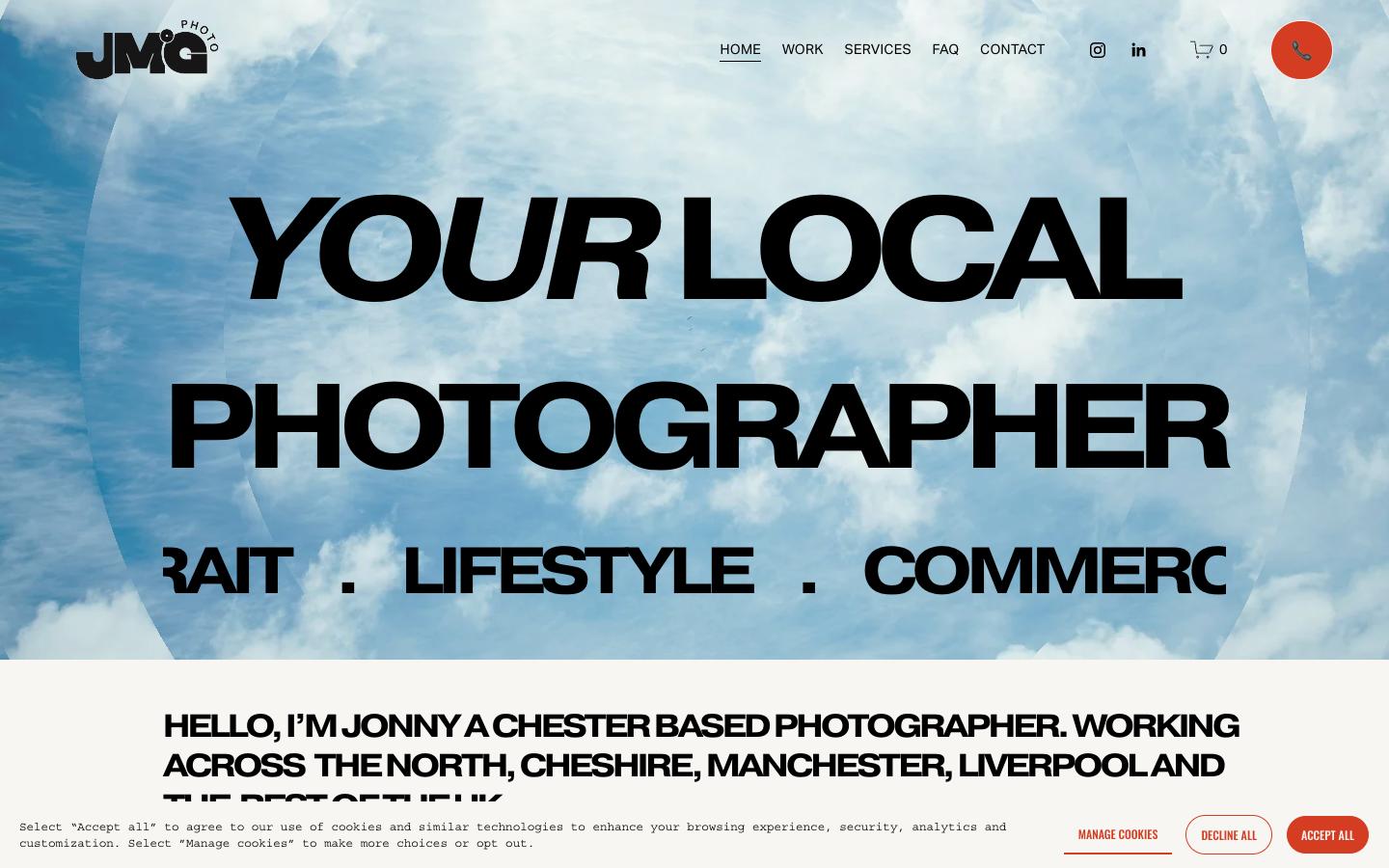
But when I reviewed his website in November 2026, SE Ranking couldn’t find it ranking in UK Google results at all. If you’ve ever asked “why is my website not showing up on Google?” when you know your work is good, Jonny’s site is a useful example. The problems weren’t about the photography. They were about how the site explains itself to Google, and almost all of them can be fixed without a rebuild.
Jonny agreed to let me share what I found, so here it is.
What I checked
I used two tools, the same ones I use for every SEO review:
- SE Ranking shows which Google searches a website appears for, and roughly how much traffic that brings in. I checked the UK Google results.
- Screaming Frog crawls a website the way Google does, page by page, and lists anything that could confuse a search engine: missing headings, repeated titles, oversized images and so on.
The site runs on Squarespace and has 14 pages.
The SE Ranking result was simple. It found no UK Google ranking data for the domain, which means organic traffic (visitors who find you through Google without paying for ads) was likely close to zero. The crawl explained why.

| What the crawl found | Pages affected (out of 14) |
|---|---|
| Shared the same page title | 12 |
| Thin content, mostly image-only galleries | 11 |
| Meta description too long | 7 |
| No main heading (H1) | 6 |
| More than one H1 | 5 |
| Meta description missing | 2 |
| Meta description duplicated | 2 |
1. Google couldn’t tell the pages apart
Every page has a page title. It’s the text in the browser tab and, more importantly, the blue headline in Google’s results. On Jonny’s site, 12 of the 14 pages had the same one.
That’s a bit like a photographer sending out 12 portfolios with the same label on the front. Google has no quick way to tell which page is about food, which is about packaging and which is the Iceland project, so it doesn’t show any of them with much confidence.
Headings tell the same story. Each page should have one H1, the main heading that says what the page is about. Six pages had no H1 at all, including Work, FAQ and the Iceland case study. Five pages had more than one, which sends mixed signals.
The meta descriptions (the short summary under the headline in Google) needed a tidy too: 2 were missing, 2 were duplicated and 7 were too long, so Google would cut them off.
Why it matters to you: titles, headings and descriptions are the first things Google reads. If they’re the same everywhere, your pages compete with each other instead of with your competitors. For a fuller list, see these SEO audit checks.
2. Beautiful galleries, but very few words
11 of the 14 pages had what SEO tools call thin content: not enough text for Google to understand what the page is about. Most of them were image-only galleries.
That’s common for photographers, and it makes sense. The pictures are the product. But Google reads text, not food. A gallery with no caption, no client name and no line about the brief looks almost empty to a search engine.
There was also no call to action. Someone who loved a set of restaurant shots had nothing on the page telling them what to do next.
Images can carry words too, through alt text: a short description that screen readers read aloud and Google uses to understand a picture. 12 images had none, and others had keyword-stuffed descriptions or raw file names.
Why it matters to you: a few sentences per gallery (who it was for, what the brief was, a link to get in touch) give Google something to rank and give visitors a reason to enquire.
3. The images were heavy
Crawl tools flag images over 100 kB as too large. Jonny’s site had 185 of them, and the largest was a 7.5 MB PNG. The homepage HTML alone was over 2 MB before any of the images loaded.
Large files make pages slow, especially on a phone with a weak signal. Slow pages lose visitors, and Google takes speed into account when it decides what to show.
Why it matters to you: photographers need their images to look their best, but a web image doesn’t need to be a print file. Exporting at the right size usually makes no visible difference on screen.
4. The best selling points were hidden
This one isn’t technical, but it might be the biggest win.
The client logos (Iceland, Heinz, ASDA and the rest) were at the bottom of the Contact page. Most visitors would never see them. On the homepage, they’d tell a marketing manager straight away that Jonny has done this for brands they know.
The services had the same problem. All eight were on a single page. A separate page for each one, such as food photography or packaging photography, gives Google a specific page to show for each search and gives visitors a clear next step.
Why it matters to you: if your best proof is buried, Google and your visitors both miss it.
What we’d fix first
I’d tackle this in two stages so the results show up quickly. Everything here can be done within Jonny’s current Squarespace site.
Stage 1: quick fixes and technical SEO
- Move the client logos to the homepage.
- Give every page its own title and meta description.
- Give every page one clear H1 heading.
- Compress the oversized images and rewrite the alt text.
- Set up Google Search Console (Google’s free tool that shows how your site is doing in search) and a Google Business Profile, so progress can be measured from day one.
Stage 2: growth
- Build a separate page for each service.
- Turn the best galleries into short case studies with the client, the brief and a link to enquire.
- Track rankings every month and report on what’s moving.
Jonny didn’t wait. He started on the fixes the day after he got the review, and by the next day each page had its own title.
Starting from almost zero search traffic has one upside: any improvement will be easy to see.
Is your site doing the same?
You don’t need any tools for most of these. Open your website and check:
- Does each page have its own title in the browser tab?
- Does each page have one main heading that says what it’s about?
- Does your homepage show who you’ve worked with?
- Does each service have its own page?
- Do your galleries say who the work was for, with a way to get in touch?
- Are your images under about 100 kB each?
- Do your images have short, plain descriptions (alt text)?
- Is your site set up in Google Search Console?
If you answered “no” to two or three of these, that could be why your website isn’t showing up on Google. It’s very common, and it applies to Squarespace, Wix and WordPress sites alike. If you’re a wedding supplier, there’s more on marketing for wedding suppliers.
Get an SEO health check
If your website looks good but nobody finds it, start with the free website SEO health check. It’s 20 plain-English checks you can run in about an hour, with a worksheet to help you decide what to fix first.
If you’d rather someone did it for you, get in touch with 53Marketing for a practical SEO review. It’s the same process I used on Jonny’s site: a ranking check, a full crawl and a clear list of fixes in order.
Thanks to Jonny for letting me share his site. You can see more of his work at jonnymcgilloway.com.