
When someone in Derry/Londonderry searches Google for a plumber, a solicitor or a florist, fewer than half of the first-page results are local businesses’ own websites. The rest are directories, booking sites, Facebook pages and chains. And many of the local websites that do make it onto page one are missing basics that help Google, and customers, understand who they are and where they work.
That’s the picture from a study I ran in October 2026. I looked at the top 20 Google results for 20 everyday Derry searches (400 results in all), then checked the homepage of every local business that appeared, 141 websites, including a mobile speed test of each one.
Key findings
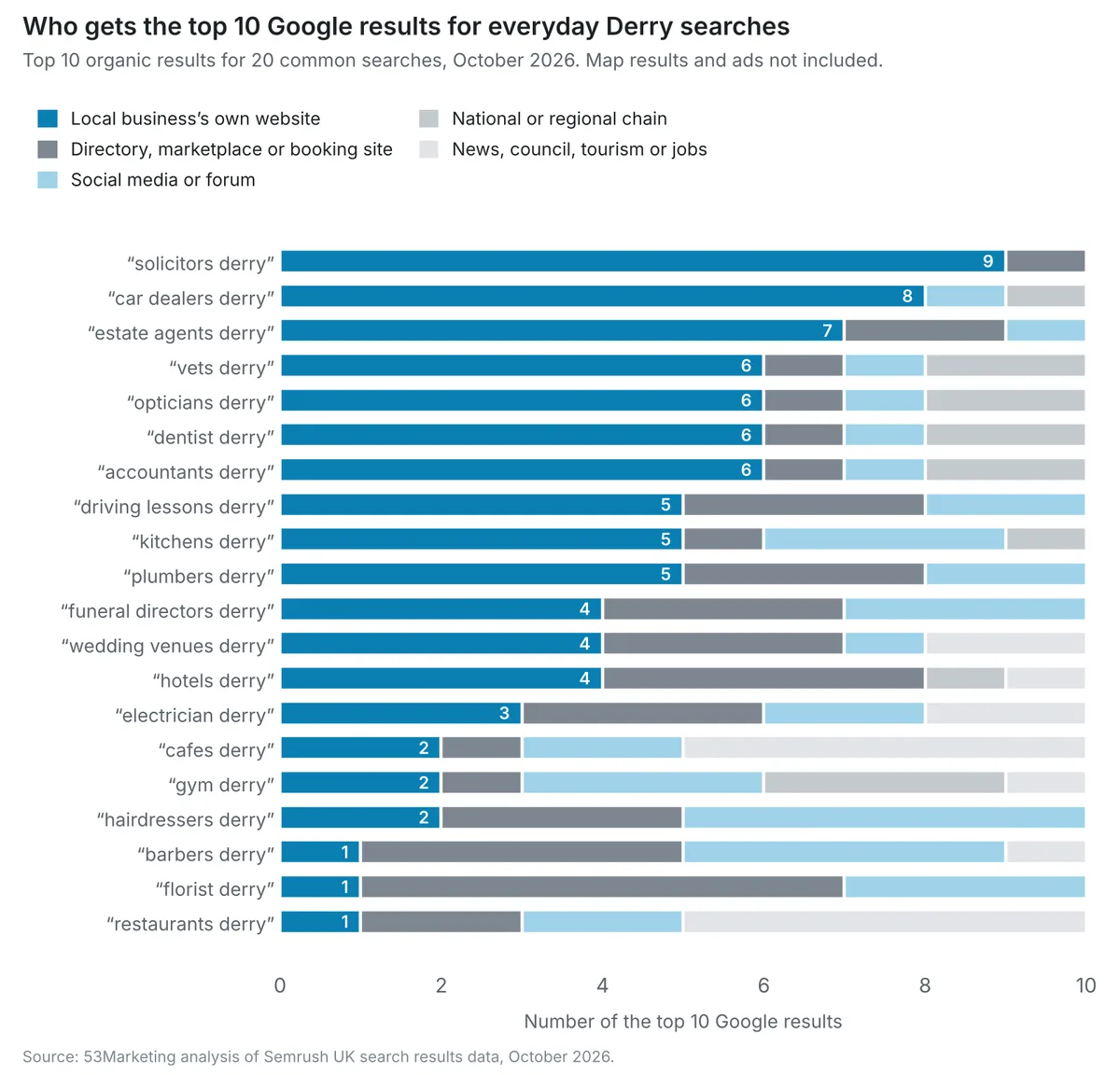
- Local businesses’ own websites made up only 44% of the top 10 results across the 20 searches. Directories and booking sites took 22%, social media and forums 19%.
- It varies hugely by sector. For “solicitors derry”, 9 of the top 10 results were local firms’ websites. For “restaurants derry”, “florist derry” and “barbers derry”, just 1 was.
- The basics are mostly there: 98% of the local websites use HTTPS and are set up for mobile screens.
- 71% have no structured data identifying them as a local business, the behind-the-scenes code that tells search engines what a business is, where it is and when it’s open.
- 38% don’t mention Derry or Londonderry in their homepage title, one of the strongest signals of where a business works.
- 32% have no tap-to-call phone link on their homepage, and 22% have neither a tap-to-call link nor a contact form there.
- Only 6 of the 133 homepages (5%) scored 90 or more for mobile speed in Google’s PageSpeed Insights. The median score was 61 out of 100, and 20% scored under 50.
- In Google’s slow-phone test, the main content took a median of 8.7 seconds to appear, against Google’s target of 2.5 seconds. Real visitors usually do better: 41 of the 54 websites with enough traffic for Google’s real-visitor data passed its Core Web Vitals check.
- About a third (34%) load Google tracking with no cookie consent tool I could recognise. That isn’t always a problem under the UK’s 2026 rules, but it’s worth checking, especially for advertising tags.
- Two websites Google was still ranking no longer worked: one showed a “hosting account suspended” page and one had become a parked domain.
Who gets the top 10 results?
For each of the 20 searches, I sorted every result into one of five groups: a local business’s own website, a directory or booking site (such as Yell, Booksy or Tripadvisor), social media or a forum (mostly Facebook, Instagram and Reddit), a national or regional chain, or a news, council, tourism or jobs page.
| Type of result | Share of the top 10 | Share of the top 3 |
|---|---|---|
| Local business’s own website | 44% | 53% |
| Directory, marketplace or booking site | 22% | 17% |
| Social media or forum | 19% | 15% |
| News, council, tourism or jobs | 9% | 7% |
| National or regional chain | 7% | 8% |
Three patterns stand out:
- Professional services own their searches. Solicitors, estate agents, accountants, dentists, opticians and vets all held six or more of the top 10 places. These are sectors where most firms have long-established websites with a page for each service.
- Hair, beauty, food and flowers have handed page one to other people’s platforms. For hairdressers and barbers, booking apps, Facebook pages and Instagram profiles took most of the top 10. For restaurants and cafés it was Tripadvisor, tourism sites and Reddit threads. A customer searching there mostly finds lists of businesses, not the businesses themselves.
- Trades sit in between. Plumbers and electricians shared page one with Yell, Bark, Checkatrade and job boards. Where a tradesperson had a clear website mentioning Derry, it usually ranked well.
This matters because a directory listing or Facebook page puts your business next to your competitors, and often ranks them above you. Your own website is the one place a customer sees only you.
What the local websites get right, and what they miss
I then checked the homepage of every local business website in the results: 141 in total, of which 133 could be analysed. Five couldn’t be tested (two were suspended or parked, and three wouldn’t load properly in the testing browser), one was a business outside the area that ranked because of its name, one redirected to another site in the sample, and one was a “website being updated” placeholder.

The good news: security and mobile are sorted
Only 3 of the 133 websites weren’t served over HTTPS, and only 3 weren’t set up to fit mobile screens. A few years ago these were among the most common problems on small business websites. Today they’re rare.
Structured data: the most common gap
Structured data is code in a page that describes the business in a format search engines read directly: its name, type, address, phone number and opening hours. Google uses it to understand local businesses. Only 29% of the homepages had it, and 46% had no structured data of any kind.
Not saying where you are
The page title, the blue headline in Google’s results, is one of the clearest places to say what you do and where. 38% of the homepages didn’t mention Derry or Londonderry in it. Some of those businesses cover a wider area, but for most, adding the city is a two-minute fix.
Making it harder to get in touch
Most local searches happen on a phone, and the quickest next step is a call. 32% of the homepages had no tap-to-call phone link, meaning a visitor has to copy the number or find the contact page. 22% had neither a tap-to-call link nor a contact form on the homepage.
Missing headings and descriptions
24% of homepages had no main (H1) heading, which helps both search engines and screen-reader users understand what the page is about. 20% had no meta description, so Google has to pick its own snippet of text to show under the result.
Signs of neglect
14% of homepages showed a copyright year of 2024 or earlier in the footer, the oldest from 2015. It’s a small thing, but visitors notice it, and it often signals that nothing else has been updated either. Two of the websites Google was still ranking had stopped working altogether: one showed a hosting “account suspended” page and one had become a parked domain advertising itself for sale.
Slow to load on a phone
I also ran every homepage through Google’s PageSpeed Insights. It loads the page on a simulated mid-range phone over a slow mobile connection and gives it a performance score out of 100. Google counts 90 or more as good and anything under 50 as poor.
| Measure (mobile test) | Result |
|---|---|
| Median performance score | 61 out of 100 |
| Scored 90 or more (good) | 6 websites (5%) |
| Scored 50 to 89 (needs improvement) | 101 websites (75%) |
| Scored under 50 (poor) | 26 websites (20%) |
| Median time for the main content to appear (Largest Contentful Paint) | 8.7 seconds |
| Main content appeared within Google’s 2.5-second target | 5 websites (4%) |
| Main content took more than 10 seconds | 55 websites (41%) |
| Layout stayed stable while loading (Cumulative Layout Shift of 0.1 or less) | 81% |
That test is deliberately tough. For websites with enough visitors, Google also publishes data from real Chrome users, and 54 of the 133 had it. Of those, 41 passed Google’s Core Web Vitals check and 13 failed. So most people on a good 4G or 5G signal get a quicker experience than the lab score suggests. The lab test shows what happens on a weak signal or an older phone, which is exactly when a slow page loses a customer.
Speed on its own didn’t decide who ranked: websites in the top 3 and those further down both had a median score of 61. But it’s one of the few things on this list a customer actually feels. When I worked on my own homepage, the mobile score went from 65 to 96. I’ve written up what I changed in my SEO audit checklist.
Cookie consent: worth checking
45 of the 133 homepages (34%) loaded Google Analytics or Google Tag Manager without any cookie consent tool my check could recognise. It looked for around 30 widely used consent tools, so some of these websites may use one it missed. I left out Wix and Shopify websites, whose built-in banners it might not have spotted.
That isn’t automatically a problem. Since February 2026, UK rules have let websites use analytics without asking first, as long as visitors are clearly told about it, can easily switch it off, and the data is only used to improve the website. Anything used for advertising, such as Google Ads conversion tracking or remarketing, still needs consent before it loads. The ICO’s guidance on the exceptions to consent explains where the line sits. If your website runs ads tracking without a cookie banner, it’s worth a look.
What the websites are built on
| Platform | Websites | Share |
|---|---|---|
| WordPress | 63 | 47% |
| Wix | 13 | 10% |
| Squarespace | 5 | 4% |
| Shopify | 3 | 2% |
| Other or custom-built | 49 | 37% |
Every one of the gaps above can be fixed on any of these platforms. None needs a new website. If you’d rather have them fixed for you, see web design in Derry/Londonderry.
What to do about it
If you run a business in Derry/Londonderry, here’s how to check your own website against the study, roughly in order of impact:
| Check | How to check | Typical fix |
|---|---|---|
| Do you appear for your main service + Derry? | Search it on your phone, logged out of Google | A clear page for each main service that says where you work |
| Does your homepage title mention Derry or Londonderry? | Look at the browser tab, or your result in Google | Edit the title in your website’s SEO settings |
| Can people tap to call? | Tap your phone number on your own phone | Turn the number into a tel: link |
| Do you have local business structured data? | Run your homepage through Google’s Rich Results Test | Add LocalBusiness markup with your name, address, phone and hours |
| One clear H1 and a meta description? | Use a free SEO browser extension or your SEO plugin | Add a main heading and a short description of what you do and where |
| Does your homepage load quickly on a phone? | Test it at PageSpeed Insights and look at the Mobile tab | Resize and compress large images, and remove plugins and scripts you don’t use |
| Are your cookies set up properly? | List the tracking your website loads, such as Google Analytics, Google Ads and the Meta Pixel | Ask consent before any advertising tags load, and tell visitors about analytics with an easy way to opt out |
| Is the footer up to date? | Scroll to the bottom of your homepage | Set the year to update automatically |
For a fuller list, my free Website SEO Health Check covers 20 checks in about an hour, and the local SEO checklist for Northern Ireland covers your Google Business Profile and reviews too.
How the study was done
- Searches: 20 everyday searches combining a common service with “derry”, such as “plumbers derry”, “dentist derry” and “wedding venues derry”. I chose searches that Semrush tracks in its UK database.
- Results: the top 20 organic Google results for each search from Semrush’s UK database, October 2026: 400 results in total. Google’s map results and ads are not included. Real results vary by location and device.
- Classification: each result was sorted by hand into one of five groups. Local business websites were those of independent businesses based in or serving the Derry/Londonderry area, including a few just across the border.
- Website checks: each local business homepage was loaded in a standard browser between 14 and 15 October 2026 and checked automatically for HTTPS, a mobile viewport, title, meta description, H1, mentions of Derry/Londonderry, tap-to-call links, contact forms, structured data, the footer copyright year, the platform, Google Analytics or Tag Manager code, and around 30 common cookie consent tools. Only homepages were checked, so a business may have some of these on other pages.
- Speed tests: each analysed homepage was tested once with Google PageSpeed Insights on mobile between 14 and 15 October 2026. These are lab tests on a simulated phone with a throttled connection, so scores vary by a few points between runs and are usually lower than what real visitors experience. Real-visitor results come from Google’s Chrome UX Report, shown in PageSpeed Insights where a website has enough traffic.
- Anonymity: results are reported only as totals. No individual business is named or scored.
Using these figures: journalists, business groups and anyone else are welcome to quote or chart these findings, with a link to this page as the source. If you’d like the underlying totals, get in touch.
Want to know how your website compares?
I’m Jamie Somers, and I run 53Marketing, a website and SEO studio in Derry/Londonderry. If you’d like me to check your website against everything in this study and tell you what to fix first, get in touch, or see my SEO services.
Sources
- Semrush UK organic search results data, October 2026
- 53Marketing homepage checks of 141 local business websites, 14–15 October 2026
- Google PageSpeed Insights mobile tests, 14–15 October 2026
- Google Search Central: Understanding Core Web Vitals and Google search results
- Google Search Central: Local business structured data
- Information Commissioner’s Office: Guidance on storage and access technologies: what are the exceptions?