
Local SEO is how a business shows up when nearby customers search: “electrician Coleraine”, “café near me”, “accountant Derry”. Most of it is free, and most of it is within your control. This checklist covers the things that matter most for local businesses in Northern Ireland, in the order I’d tackle them.
Work through it with a pen. For each item, note Yes, No or Not sure. Anything marked No goes on your to-do list. To check the website side in more detail, use the free Website SEO Health Check alongside this one. For the reasoning behind each step, see our practical guide to small business SEO in Northern Ireland.
Where to start
If you can’t do everything at once, work in this order. The early steps are quick and make the biggest difference; links take longest, so they come once the basics are right.
| Order | What to do | Why it comes here |
|---|---|---|
| 1 | Fix your Google Business Profile: real name, primary category, hours and service area | It’s often the first thing customers see, and the category decides which searches you can appear for |
| 2 | Start asking every happy customer for a review | Reviews build up slowly, so the sooner you start, the better |
| 3 | Give each main service a clear page that says where you work | It tells customers and Google what you do and where |
| 4 | Set up Bing Places and Apple Business Connect, and correct old listings | Quick to do, and keeps your details consistent everywhere |
| 5 | Earn a few genuine local links | It takes longest, so it pays off once the basics are in place |
1. Google Business Profile
Your Business Profile is what appears in Google Maps and the map results. It’s the most important part of local SEO for most small businesses.
- The profile is claimed and verified, and you can log in to it.
- The business name is your real name, exactly as it appears on your signage and paperwork. Adding keywords or towns to the name breaks Google’s guidelines and can get a profile suspended.
- The primary category is the most specific one that fits, such as “Electrician” rather than “Contractor”. It’s one of the biggest influences on which searches you appear for.
- Secondary categories cover your other main services, without adding ones you don’t really offer.
- Address or service area is set correctly. If customers don’t visit you, hide the address and list the areas you cover instead.
- Phone number, website and opening hours are correct, including holiday hours.
- Services are listed, each with a short description in plain words.
- The description explains what you do and where, in the words a customer would use.
- There are recent, real photos: your work, your premises or vehicles, and you or your team. Add new ones every month or two.
- You post updates occasionally, such as a recent job, an offer or seasonal advice.
2. Reviews
- You ask every happy customer for a review, with a direct link, soon after the job is done.
- Reviews keep arriving, not just a burst once a year. Recent reviews matter to customers as much as the total.
- You reply to every review, including negative ones, politely and promptly.
- You don’t offer anything in exchange for reviews, and you don’t only ask customers you expect to be positive. Both break Google’s rules.
- Customers mention the service and the town when it’s natural. You can’t script reviews, but you can ask, for example, “It would help if you mentioned what we did for you.”
For more on this, see our guide to Google reviews for Northern Ireland businesses.
3. Your website
- Each main service has its own page that says clearly what you do and which areas you cover.
- Page titles include the service and the place, such as “Boiler Servicing in Omagh | Smith Heating”.
- Your name, address (if public) and phone number are on every page, usually in the footer, and match your Business Profile exactly.
- The phone number can be tapped to call on a mobile, and it’s easy to find.
- The site works well on a phone and loads quickly. Most local searches happen on mobiles.
- Location pages are genuine. If you add pages for towns you serve, give each one real local detail: jobs you’ve done there, areas covered, travel times. Copies with only the town name swapped help nobody, and Google treats them as low quality.
- Structured data tells search engines your business details, such as name, phone, area and opening hours. Your web designer or SEO plugin can add it.
4. Listings and directories
- Bing Places is set up. It can import your details straight from Google Business Profile.
- Apple Business Connect is set up, so you appear correctly in Apple Maps on iPhones.
- You’re listed on the main UK directories, such as Yell, Thomson Local and FreeIndex, and on any directories that already appear when you search for your service and town.
- You’re listed with relevant trade bodies or your local chamber of commerce, if you’re a member.
- Every listing uses exactly the same name, phone number and website. Old listings with a previous phone number or address are corrected or removed.
- You haven’t bought a “citation package”. A handful of accurate listings on real directories is worth more than hundreds on sites nobody visits.
5. Local links and mentions
- Suppliers, partners and customers you work with link to you where it makes sense, for example on a list of approved installers or recommended suppliers.
- Community involvement is visible: local clubs, charities or events you support often list sponsors on their websites.
- Local press and radio know about you. A genuinely newsworthy story, such as a milestone, a new service or a community project, can earn coverage and a link.
- You haven’t paid for links. Bought links and link packages are against Google’s guidelines and usually do nothing at best.
6. Tracking what’s working
- You check your Business Profile performance monthly: calls, website clicks and direction requests.
- Google Search Console is set up, so you can see which searches show your site, including ones with town names.
- You know how customers found you. Ask new enquiries, and track form submissions on your website where you can.
Realistic expectations
Map results depend heavily on how close a business is to the person searching, and nobody can change where your business is. A plumber based in Strabane will find it hard to appear in the Derry map results for someone searching in the city centre, however good the profile. Competition, your category and how established your profile is also play a part. What this checklist can do is make sure you appear wherever you reasonably should, and that customers trust what they see when you do.
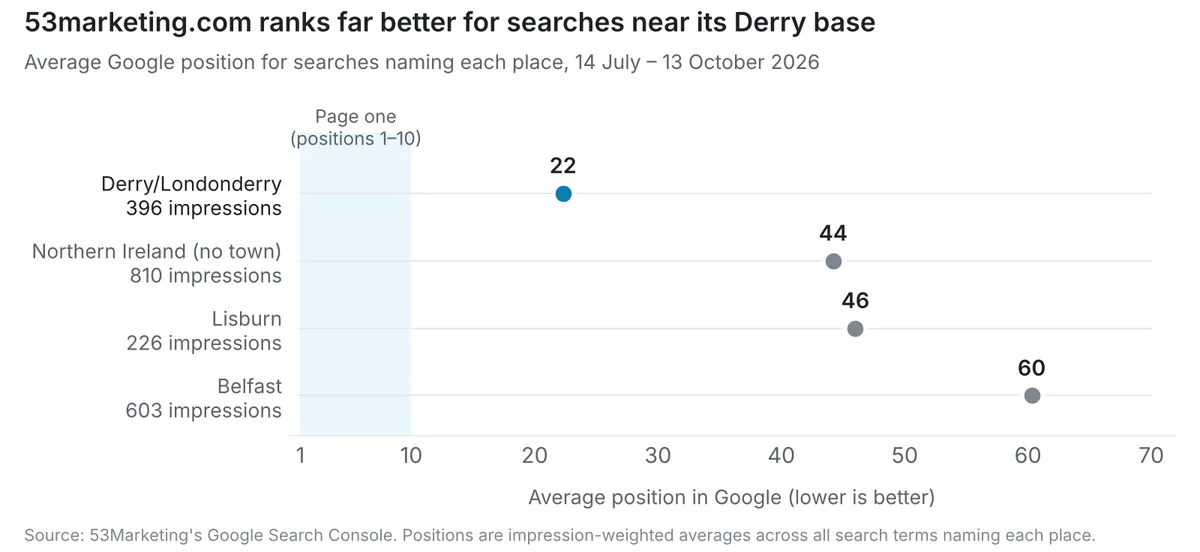
You can see this on my own site. Searches that name Derry or Londonderry find 53marketing.com around position 22 on average; searches naming Belfast, about 70 miles away, find it around position 60. There’s more on this in the case study in our small business SEO guide.
Changes to your profile can show within days. Rankings in the map and normal search results usually take longer, often a few months.
Common questions
Do I need a business address to do local SEO?
No. Service-area businesses, such as trades that work at customers’ homes, can hide their address on Google Business Profile and list the areas they cover instead. You still need a real address for Google to verify the business.
Should I make a page for every town I cover?
Only where you can make each page genuinely useful. A few strong pages for the main areas you work in beat dozens of near-identical ones.
Does posting on Google Business Profile help?
Posts keep your profile looking active and give customers more reasons to get in touch. Reviews, the right category and accurate details matter more, so get those right first.
Is local SEO different in Northern Ireland?
The principles are the same as anywhere. The differences are local: place names (Derry and Londonderry are both searched), customers crossing the border from Donegal, Louth or Monaghan, and Irish as well as UK directories being worth checking if you serve both.
Want this done for you?
The Local SEO Fix covers the essentials in one go for £395: titles, descriptions and headings on up to five key pages, straightforward indexing and broken-link fixes, contact-form testing, a Google Business Profile set-up or tidy-up, and a written summary of what was done. For ongoing help, SEO Lite is £295 a month and includes monthly Business Profile support. No rankings are guaranteed.
