
The easiest keywords for a local business to win are specific ones: a service, a town and a reason to buy, like “emergency plumber Belfast” or “gym Newry no contract”. Fewer people search them than “plumber”, but the people who do are ready to hire, and you’re competing with a handful of local firms instead of national brands.
You can find them in about an hour with free tools: Google’s own search suggestions, your Search Console data and Google’s Keyword Planner. This guide shows how, using real search data and my own site, 53marketing.com, as the example.
Updated 14 October 2026: rewritten with Semrush search data, 53Marketing’s own Search Console results and links to Google’s documentation.
Why local keywords are easier to win
Here’s the difference in numbers. The table compares broad national searches with local versions, using Semrush’s UK data. Keyword difficulty is Semrush’s 0 to 100 estimate of how hard it is to reach the first page; lower is easier.
| Search | Monthly UK searches | Keyword difficulty (0–100) |
|---|---|---|
| plumber | 22,200 | 41 |
| plumber belfast | 390 | 17 |
| emergency plumber belfast | 210 | 4 |
| plumber derry | 70 | 0 |
| accountant | 18,100 | 72 |
| accountant enniskillen | 10 | 0 |
| web design derry | 390 | 30 |
| gym newry | 480 | 12 |
| brunch derry | 260 | 24 |
“Plumber” gets tens of thousands of searches, but most of those people aren’t in Northern Ireland and the results are full of national directories. “Emergency plumber Belfast” gets about 210 searches a month with a difficulty of 4, and every one of those people needs a plumber in Belfast today. For a local business, that’s the better target.
Don’t be put off by small numbers. Even “accountant Enniskillen”, at around 10 searches a month, could be worth thousands of pounds a year if it brings in two new clients.
The formula: service + place + intent
Most of your best keywords combine three things:
- Service: what you do, in the words customers use (plumber, café, accountant, physio).
- Place: the town or area you serve (Derry, Newry, Bangor) or “near me”.
- Intent: a word that shows they’re ready to act (emergency, same day, prices, no contract, book).
Questions make good keywords too, for FAQs and blog posts rather than service pages. Some examples by sector:
| Sector | Service page keywords | Question keywords for FAQs or posts |
|---|---|---|
| Trades | boiler service Belfast; emergency electrician Newry | how much does a boiler service cost in Belfast? |
| Hospitality | brunch Derry city centre; family hotel Portrush | is there parking near [your café]? |
| Fitness | gym Newry no contract; personal trainer Lisburn | how much is a gym membership in Newry? |
| Professional services | accountant Enniskillen small business; solicitor Portadown wills | how much does a will cost in Northern Ireland? |
Step 1: use Google’s own suggestions
Start typing a search into Google and it suggests ways to finish it, based on what people search. It’s free and takes seconds.
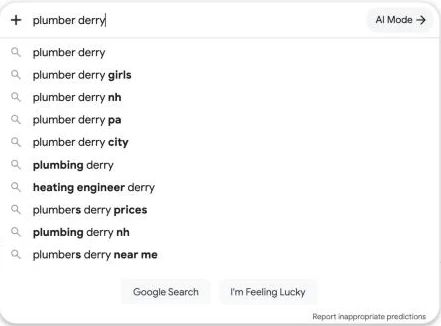
This screenshot shows both sides of autocomplete. There are useful ideas: “heating engineer derry” (a different way of describing the same job), “plumbers derry prices” (someone comparing costs) and “plumbing derry”. There’s also noise: Derry in New Hampshire, Derry in Pennsylvania and, inevitably, Derry Girls. Keep the useful ones and ignore the rest.
Try a few variations, such as adding a letter after your phrase (“plumber derry a”, “plumber derry b”) or swapping in other towns you cover. Then search one of your phrases and look at the People also ask questions and the related searches at the bottom of the results. Copy anything relevant into a spreadsheet with three columns: keyword, which service it matches, and notes.
Step 2: find your “almost there” keywords in Search Console
Google Search Console is free and shows the searches your site already appears for. If you don’t have it set up, that’s the first job.
- Open Performance, then Search results.
- Set the date range to the last three months and tick Average position.
- On the Queries tab, ignore searches for your business name.
- Look for searches where your average position is between about 8 and 20: the bottom of page one or the top of page two.
Those are your “almost there” keywords. Google already sees your site as relevant, so improving the right page can move it onto page one faster than starting from nothing. Here’s what that looks like for my own site:
Four searches sit in the “almost there” band, and three of them mention Derry. “seo agency derry”, “seo londonderry” and “local seo services derry” are just behind, in the 20s. Belfast searches are back on pages six and seven. That told me where to focus: in October 2026 I rewrote my SEO services page around Derry/Londonderry instead of trying to compete in Belfast.
For each “almost there” keyword, find the page that’s appearing for it (click the query, then the Pages tab) and check:
- Does the page title include the service and the place?
- Does the main heading say the same thing?
- Does the first paragraph answer what that searcher wants: what you do, where, what it costs and how to get in touch?
- Do other pages on your site link to it with clear wording?
- Would two or three FAQs answer the obvious follow-up questions?
Step 3: check search volumes with Keyword Planner
Google Keyword Planner is free inside a Google Ads account, and you don’t have to run ads to use it. In Google Ads, open Tools, then Keyword Planner, then Discover new keywords. Enter a few of your phrases and set the location to Northern Ireland or the area you serve.
You’ll get related ideas and monthly search estimates. If you’re not running ads, it usually shows ranges such as 10–100 rather than exact figures. That’s fine: you’re comparing ideas, not forecasting to the visit.
Paid tools such as Semrush, which I used for the table above, add keyword difficulty scores and competitor data, and most have a limited free tier. They’re useful, but you don’t need one to get started. Aim to finish this step with 10 to 20 phrases that match your services and places.
Step 4: check the competition yourself
Search each phrase and look at the first page:
- Mostly local businesses like yours? That’s a realistic target.
- Mostly national brands and directories (Checkatrade, Yell, Booking.com, Tripadvisor)? Harder. Keep it for later, and make sure you’re listed on the directories themselves.
Then score each phrase in your spreadsheet on intent (are they ready to buy?) and competition (local or national results?). Start with five to ten phrases that are high intent and mostly local competition.
Step 5: give each group of keywords one strong page
Don’t build a separate page for every variation. “Emergency plumber Belfast”, “24 hour plumber Belfast” and “plumber Belfast emergency” are the same need, so they belong on one page that covers response times, areas, prices and how to call you.
The same goes for towns. A set of near-identical pages that only swap the town name is what Google calls doorway abuse in its spam policies. A separate page for another town is only worth it if you have something different to say there: real jobs, local details, a different team or address.
As a rule of thumb:
- Service pages target “service + place” keywords. Most small businesses need three to five.
- Blog posts and FAQs target questions, and link back to the matching service page.
An hour a month to keep it going
- 30 minutes in Search Console: compare the last three months with the three before. Look for new searches you’re appearing for and anything that’s moved into positions 8 to 20.
- 30 minutes planning: pick one page to improve and one or two questions to answer next month.
Done consistently, that’s twelve improved pages and a dozen or more useful articles a year.
Common mistakes
- Chasing national keywords. “Accountant” has a difficulty of 72 and almost none of those searchers are near you.
- One page per tiny variation. It splits your effort and can look like doorway pages.
- Using your words, not theirs. You might say “heating engineer”; your customers might search “plumber”. The suggestions in step 1 tell you which.
- Ignoring what you already rank for. Search Console often shows easier wins than any keyword tool.
Your keyword checklist
- List your services and the places you serve.
- Collect phrases from Google’s suggestions, People also ask and related searches.
- Find your “almost there” keywords (positions 8 to 20) in Search Console.
- Check volumes in Keyword Planner and keep 10 to 20 phrases.
- Check who’s on page one, and prioritise five to ten realistic, high-intent phrases.
- Give each group of phrases one strong page.
- Review monthly in Search Console.
For the bigger picture, including how keywords fit with your Google Business Profile and reviews, see my small business SEO guide for Northern Ireland and the local SEO checklist.
Next steps
To check the basics before you start writing, run the free Website SEO Health Check. It covers page titles, headings, local signals and more in about an hour.
If you’d rather have the keyword research and page changes done for you, see SEO services in Derry/Londonderry and across Northern Ireland, or the one-off Local SEO Fix for £395 if your main goal is showing up in local searches. Or get in touch.
Sources
- Semrush keyword data, UK database, October 2026
- 53Marketing’s Google Search Console, 14 July to 12 October 2026
- Google Ads Help: Use Keyword Planner
- Google Search Central: Spam policies for Google web search (doorway abuse)