
Small business SEO in Northern Ireland mostly comes down to four things: a complete Google Business Profile, a website with a clear page for each service you offer, a steady flow of genuine reviews, and a few real links and mentions from local organisations. None of it needs a big budget. It does need doing properly, and it takes months rather than weeks to show.
This guide is what I’d tell a local business owner who asked me where to start. It’s based on the work I do building and fixing websites for businesses across Northern Ireland, on Google’s own guidance, and on what I can see in the data for my own site. Where Google publishes a rule, I’ve linked to it.
The short version
- Get your Google Business Profile right first. For most local businesses it brings more calls than the website.
- Give each main service its own page that says what you do, roughly what it costs and where you work.
- Ask every happy customer for a review, with a direct link, and reply to all of them.
- Earn a handful of real local links from suppliers, trade bodies, clubs and local press. Never buy them.
- Expect it to take three to six months before rankings move much, and longer in competitive trades.
How Google decides which local businesses to show
Google says local results are based mainly on relevance, distance and prominence. Relevance is how well your profile and website match the search. Distance is how far you are from the person searching, or from the place they named. Prominence is how well known and trusted your business is, which includes reviews, links and mentions elsewhere.
You can improve relevance and prominence. You can’t change distance, and in Northern Ireland that matters more than people expect. A business in Derry will find it much easier to appear for searches in Derry than in Belfast, however good its website is. (More on that in SEO for Belfast businesses.)
An example from my own site
My own Search Console data shows this clearly. Between mid-July and mid-October 2026, searches that named Derry or Londonderry found 53marketing.com at an average position of about 22. Searches naming Belfast, around 70 miles away, found it at about 60, on page six of the results. Same business, same website: Google treats me as far more relevant close to home.
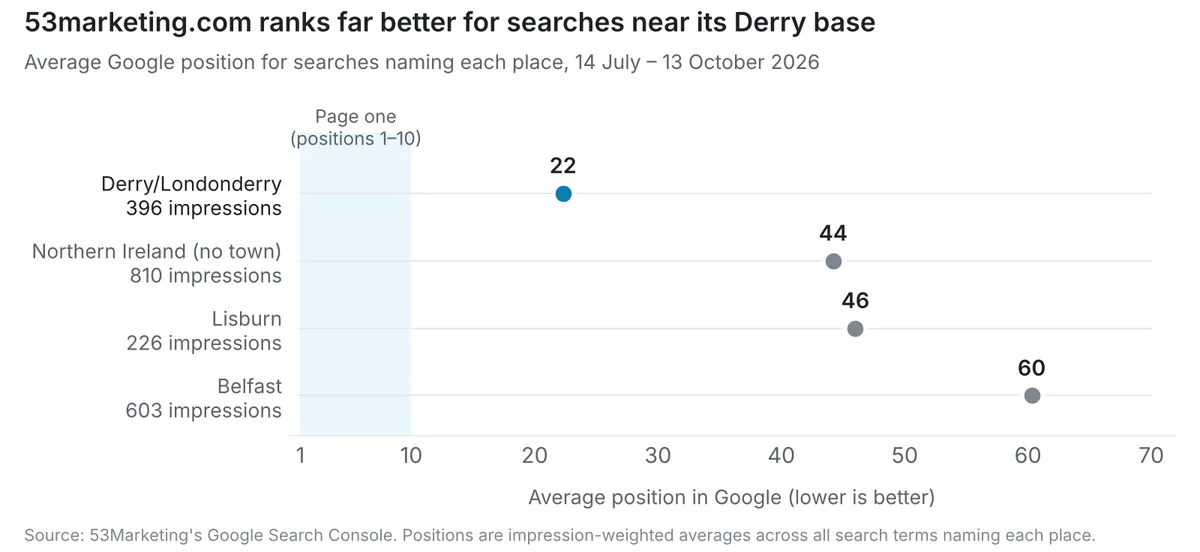
| Searches naming | Impressions | Average position |
|---|---|---|
| Derry/Londonderry | 396 | 22 |
| Northern Ireland (no town) | 810 | 44 |
| Lisburn | 226 | 46 |
| Belfast | 603 | 60 |
That’s why the advice below starts with the area you actually serve.
What’s different about Northern Ireland
- Smaller search volumes. Fewer people search for most services than in a big English city, so there’s less competition, but each search matters more.
- Place names vary. People search for both Derry and Londonderry, and local areas and townlands as well as towns. Use the names your customers use.
- Customers cross the border. If you serve Donegal, Louth or Monaghan, say so on your site and consider Irish directories as well as UK ones.
Step 1: Get your Google Business Profile right
Your Business Profile is the listing with your map pin, reviews, phone number and photos. It’s free, and for searches like “electrician Omagh” it’s often the first thing a customer sees.
- Use your real business name. Google’s guidelines for representing your business don’t allow extra keywords, taglines or locations in the name. Adding them can get a profile suspended.
- Choose the most specific primary category that fits, such as “Electrician” rather than “Contractor”. Add secondary categories only for services you really offer.
- Set your address or service area correctly. If customers don’t visit you, Google says to remove your address and list the areas you serve instead.
- Keep phone number, website and hours accurate, including bank holidays.
- List your services with a short, plain description of each.
- Add real photos of your work, your premises or van, and your team, and add new ones every month or two.
- Post updates occasionally: a recent job, an offer, seasonal advice. Posts make a profile look active and give people a reason to get in touch. They matter less than categories, reviews and accurate details, so get those right first.
Step 2: Build a steady flow of genuine reviews
Reviews help you rank, and they help people choose you once they’ve found you. A steady trickle of recent reviews looks better to customers than a burst two years ago.
- Ask at the right moment, just after you’ve finished the job and the customer is happy.
- Send a direct review link by text, WhatsApp or email. You’ll find it in your Business Profile under “Ask for reviews” or “Get more reviews”.
- Reply to every review, including negative ones, politely and promptly.
- Don’t offer anything in return, and don’t only ask customers you expect to be positive. Google’s policy on prohibited content bans incentives and selectively asking for positive reviews.
There’s a fuller walkthrough, including example messages, in our guide to Google reviews for Northern Ireland businesses.
Step 3: Make your website clear about what you do and where
Google’s SEO Starter Guide is worth reading, but for a local business the priorities are simple.
One page for each main service
A single “Services” page listing everything is hard to rank and hard to read. Give each main service its own page that covers what’s included, how pricing works or a typical starting price, the areas you cover, the questions customers usually ask, and how to get in touch. Put the service and the place in the page title and main heading, for example “Boiler Servicing in Derry/Londonderry”.
Location pages only where they’re genuine
If you add pages for towns you serve, give each one real detail: jobs you’ve done there, the areas covered, travel times, anything specific to that place. Pages that are copies with the town name swapped are treated as low quality and don’t help. A few strong pages for the places you really work beat dozens of thin ones.
The basics that quietly cost you enquiries
- Your name, address (if public) and phone number on every page, matching your Business Profile exactly.
- A phone number that can be tapped to call on a mobile.
- A site that loads quickly and works well on a phone. Test it with Google’s free PageSpeed Insights, then try it on your own phone.
- Contact forms that work. Send a test message every month. Forms break quietly after updates.
- Links between related pages, such as from a blog post to the service it’s about.
- Structured data describing your business, its services and the areas you serve. Your web designer or SEO plugin can add it.
To check your own site against a longer list, use the free Website SEO Health Check.
Step 4: Target the searches your customers actually make
Broad terms like “plumber” or “web design” are hard to win and attract people you can’t serve. The searches that bring enquiries are usually a service plus a place, such as “boiler repair Coleraine” or “wedding photographer Derry”, or a specific question, such as “how much does a new consumer unit cost”.
- Type your service into Google and note the suggestions and the “People also ask” questions.
- Check Google Search Console for searches where you already appear but rank on page two. They’re often the quickest wins.
- Write down the questions customers ask you on the phone. Each one is a possible page or FAQ.
Our guide to finding easier SEO keywords for NI small businesses goes through this step by step.
Step 5: Get listed and earn local links
Listings
Beyond Google, set up Bing Places, which can import your Google details, and Apple Business Connect so you appear correctly on iPhones. Then list the business on the main UK directories, your trade body and your local chamber of commerce. Use exactly the same name, phone number and website everywhere, and correct old listings with a previous number or address. A handful of accurate listings beats hundreds on sites nobody visits.
Links and mentions
Links from relevant local organisations tell Google you’re a real, established business. Good sources in Northern Ireland include:
- Suppliers and manufacturers with a list of approved installers or stockists
- Trade bodies and accreditation schemes you belong to
- Local clubs, charities and events you support, which often list sponsors
- Business partners whose customers would genuinely benefit from knowing about you
- Local press and radio, for genuinely newsworthy stories such as a milestone, a new service or a community project
Don’t buy links or link packages. Google’s spam policies treat buying links for ranking as link spam, and at best they do nothing.
Step 6: Publish content that answers real questions
You don’t need to blog every week. One genuinely useful page a month is plenty for most small businesses. The best topics are the questions you’re asked all the time: what something costs, how long it takes, what to check before you hire someone, what to do in an emergency.
Google’s guidance on creating helpful, people-first content asks whether content shows first-hand expertise. That’s your advantage over a national website. Use your own prices, photos of your own jobs, and examples from your own customers, with their permission.
You can see how I’ve applied this to my own website in the case study further down.
What AI search changes
Google’s AI Overviews now appear above the normal results for many searches, and tools like ChatGPT and Microsoft Copilot answer questions directly. For a small business that means:
- Simple information searches send fewer clicks, because the answer is often shown directly.
- Searches for a service in a place still lead to businesses, and AI answers often draw on Business Profiles and reviews.
- Clear, specific pages are the ones that get quoted. Answer the question in the first sentence or two, then give the detail.
Google says there are no additional requirements to appear in AI Overviews or AI Mode, so be wary of anyone selling special “AI optimisation”. It’s also worth setting up Bing Webmaster Tools and Bing Places, because Microsoft’s Copilot draws on Bing.
Case study: applying this guide to 53marketing.com
I’ve applied this guide to my own website, so here’s where it started and what I changed in October 2026. Search results take months to respond, so I’ll update this section with the results in early 2027, whatever they show.
The starting point
In the six months to 11 October 2026, the site had 85 clicks from about 4,360 appearances in Google search, a click-through rate of 1.9%.

In mid-August I published new SEO service pages. Weekly impressions jumped from about 52 to about 429, but clicks only went from about 2.4 a week to about 5. The new pages were being shown for searches like “seo company belfast” and “seo northern ireland”, but mostly on pages four to six of the results, where hardly anyone clicks. Appearing more often isn’t the same as being chosen.
What I found and what I changed
| What I found | What I changed |
|---|---|
| Two pages competing for the same searches: a Belfast SEO page and the main SEO services page. | Redirected the Belfast page into the SEO services page, and rewrote its title, description and FAQs. |
| The website design page didn’t say where I’m based. | Retitled it “Web Design Derry/Londonderry & Northern Ireland” and rewrote the description around Derry/Londonderry. |
| No structured data describing the services. | Added Service and LocalBusiness structured data. |
| Blog posts showed no author, and the hidden author data had no name in it. | Added a byline and author box to every post, and fixed the author data so it names me. |
| Several articles covered the same ground, and some included statistics with no source. | Merged them into this guide, removed the unsupported figures and redirected the old addresses here. |
| The privacy policy and footer didn’t name the company behind the site. | Added the registered company name and number to both. |
| The Google Business Profile wasn’t fully filled in. | Updated the profile’s details. |
What I’m measuring
- Average position for Derry/Londonderry searches, currently about 22. The aim is page one.
- Clicks per week from Google, currently about 5.
- Enquiries through the contact form and by phone that started with a search.
A routine you can keep: 60 minutes a week
Once the foundations are in place, SEO is mostly steady upkeep. Split an hour a week into four short blocks:
- Business Profile (15 minutes): add a photo of recent work, reply to reviews and questions, and post an update if you have something worth saying.
- Reviews (15 minutes): send review requests to customers from the past week.
- Website (15 minutes): improve one page. Add an FAQ you were asked this week, update a price, or add a recent job.
- Numbers (15 minutes): look at calls, website clicks and direction requests in your Business Profile, and searches and clicks in Search Console.
A 90-day plan
Month 1: foundations. Complete your Business Profile, set up Search Console and analytics, make your name, address and phone number consistent everywhere, and start asking every happy customer for a review.
Month 2: the website. Fix speed and mobile problems, test your forms, and create or rewrite a page for each main service, with the areas you cover and the questions customers ask.
Month 3: reach. Set up Bing Places and Apple Business Connect, correct old directory listings, ask suppliers and partners about links, and publish one or two useful articles based on real customer questions.
After that, keep to the weekly routine and review what’s working every month.
How to tell whether it’s working
- Business Profile performance: calls, website clicks, direction requests and the searches people used to find you.
- Search Console: which searches show your site, your average position, and clicks. Watch the searches that include your town names.
- Enquiries: track form submissions and phone clicks, and ask every new customer how they found you. This is the number that matters.
Changes to your profile can show within days. Rankings in the map and normal results usually take a few months, and how far they move depends on competition and where you’re based. Nobody can guarantee positions, so be wary of anyone who does.
Doing it yourself or getting help
Most of this guide is work you can do yourself if you can set aside an hour a week. It makes sense to get help when you don’t have that time, your website itself needs fixing, you’re in a competitive trade, or you’ve done the basics and want to go further.
If you want it done for you, 53Marketing’s Local SEO Fix covers the essentials in one go for £395. SEO Lite is £295 a month for steady ongoing work, and full monthly SEO services in Northern Ireland start from £1,200 a month. You deal directly with the person doing the work, and you get a written scope before anything starts. Our guide to how much SEO costs in the UK explains what’s typical across the market.
Common questions
Is SEO worth it for a small business in Northern Ireland?
Usually, yes. People still search when they’re ready to hire a local business, and in a smaller market a well-kept profile and website can stand out quickly. It’s least worthwhile for businesses that already have more work than they can handle through word of mouth.
How long does local SEO take?
Profile changes can show within days. Ranking improvements usually take three to six months, and longer for competitive searches or in Belfast.
Do I need a business address to appear in Google Maps?
You need a real address to verify the profile, but if customers don’t visit you, you can hide it and list the areas you serve instead.
Should I make a page for every town I cover?
Only where you can make each page genuinely useful, with real local detail. A few strong pages for the main places you work are better than many near-identical ones.
Do I need paid SEO tools?
Not to start. Google Business Profile, Search Console, PageSpeed Insights and Google’s own search suggestions cover most of what a small business needs. Paid tools such as Semrush or Ahrefs help with competitor and keyword research once the basics are done.
Does AI search mean SEO no longer matters?
No. AI answers draw on websites, Business Profiles and reviews, so the same work helps with both. Clear pages that answer real questions directly are the ones most likely to be quoted.
Sources
- Google Business Profile Help: Tips to improve your local ranking on Google
- Google Business Profile Help: Guidelines for representing your business on Google
- Google Business Profile Help: Manage your service areas
- Maps User Generated Content Policy: Prohibited and restricted content
- Google Search Central: SEO Starter Guide
- Google Search Central: Creating helpful, reliable, people-first content
- Google Search Central: AI features and your website
- Google Search Central: Spam policies for Google web search
- 53Marketing’s own Google Search Console data, April to October 2026